RegoXchange
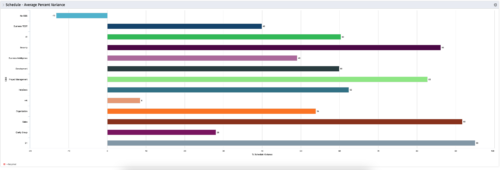
  • This is a graphic portlet that pulls the average schedule variance by OBS node of the project.  The portlet allows you to choose any OBS that is associated to the Project Object. Users can filter by:
    1. OBS Type
    2. If the project is financially approved?
    3. Financial Status
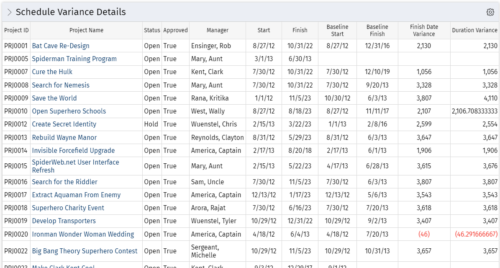
  • This portlet shows the variance between the schedule finish and baseline finish for projects. The portlet also displays the schedule variance: {(Finish-Start) – (Baseline Finish-Baseline Start)}.
  • This portlet shows the variance between the schedule finish and baseline finish for projects. The portlet also displays the schedule variance: {(Finish-Start) – (Baseline Finish-Baseline Start)}.
  • This portlet shows the variance between the schedule finish and baseline finish for projects. The portlet also displays the schedule variance: {(Finish-Start) – (Baseline Finish-Baseline Start)}.
  • The Scheduled Jobs Cleanup process removes all completed job instances that have run before a date set by the administrator. The administrator may use the gel parameter to update the amount of days since each job has run. Based on that date, the workflow will eliminate all jobs that have surpassed that threshold. This workflow helps administrators maintain the job logs and queue by eliminating jobs that users have potentially forgotten to remove on their own.
  • The Scheduled Jobs Cleanup process removes all completed job instances that have run before a date set by the administrator. The administrator may use the gel parameter to update the amount of days since each job has run. Based on that date, the workflow will eliminate all jobs that have surpassed that threshold. This workflow helps administrators maintain the job logs and queue by eliminating jobs that users have potentially forgotten to remove on their own.
  • The Scheduled Jobs Cleanup process removes all completed job instances that have run before a date set by the administrator. The administrator may use the gel parameter to update the amount of days since each job has run. Based on that date, the workflow will eliminate all jobs that have surpassed that threshold. This workflow helps administrators maintain the job logs and queue by eliminating jobs that users have potentially forgotten to remove on their own.
  • We will delve into various examples of how to use Apptio reports to identify cost-saving opportunities within your organization and how to quantify them for leadership. We will cover specific areas such as databases, migrating servers to the cloud, rationalizing applications with high unit costs, replacing or decommissioning obsolete servers, and managing unassigned end-user devices.
  • Join us to discuss one of the most important - but also one of the most confusing Clarity topics - security. Learn how an OBS can be utilized to control security, how security permissions can be granted and revoked, and the pros and cons of the different types of security permissions.
  • The Self Assign workflow process updates a selected resource field on an object based on someone checking a boolean field on the same object. Using this process, whomever is editing the object, will be placed in this field automatically eliminating the need for each user to come in and update the field manually. The field will run when the Boolean is ticked and the user saves the page. It is important to note that the page will need to be reloaded to see the changes reflected.  This can be used as a fast way to self-assign yourself to an object - you can create a boolean field that is checked and have the process assign you to that item.
  • The Self Assign workflow process updates a selected resource field on an object based on someone checking a boolean field on the same object. Using this process, whomever is editing the object, will be placed in this field automatically eliminating the need for each user to come in and update the field manually. The field will run when the Boolean is ticked and the user saves the page. It is important to note that the page will need to be reloaded to see the changes reflected.  This can be used as a fast way to self-assign yourself to an object - you can create a boolean field that is checked and have the process assign you to that item.
  • Course Description:   Do some folks in your organization view Clarity PPM as worthless or of little value? In this class, we will discuss how to increase the value perception of Clarity PPM and innovative ways to sell the value Clarity PPM provides to stakeholders and users.
  • Course Description:   For clients that have both ServiceNow and Clarity PPM, passing information between the systems becomes vital for the enterprise with ITSM, demand, and PPM toolsets. One of the biggest areas of interaction is around demand management. Come and see Rego's integration solution, which flexibly allows for ServiceNow records (incident, problem, idea, enhancement, and demands) to generate Clarity PPM ideas or projects.
  • This process must be run using the “Execute a Process” job.  Job may be scheduled or run on-demand.  Process pulls Availability Rate from the Availability blob for each resource, where blob is not null.  Then it populates this value into a custom Daily Availability attribute (Number field with 2 decimals) on the Resource object.  This field does not have to be displayed to be used for reporting. Because the OOB Availability Rate field is stored only in a blob, it is difficult to include in portlet or report output.  The use of this custom attribute makes the value easily reportable.
  • Resource Management - Are You Doing it Right? Companies of all shapes and sizes need to know if they have the right people working on the right things at the right time, to meet their objectives. Rego's own Grant Zemont has put together this report to help your company learn the best practices for setting up a resource management office correctly. Download the free report here. This White Paper is downloaded from the Rego Consulting site. You will be asked to provide your email address and current ppm tool. - http://info.regoconsulting.com/rmo-report ** Do not Add to Cart - No Downloadable File**
  • Course description: “Does your organization struggle with resource management? Have you considered creating a Resource Management Office (RMO)? This session will review how some organizations are using RMOs to drive adoption and effectively manage resources, including real world examples of RMO setup and execution.”  Download file is the presentation slide deck.
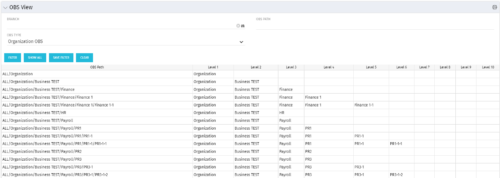
  • This grid portlet shows the OBS name and ID along with the associated hierarchy, both as an aggregated view along with each of the levels broken out. The table below describes the available filter fields in the portlet.
    Column Label Description
    Branch Branch of the OBS
    OBS Type OBS to use
    OBS Path Path of the OBS
  • This grid portlet shows the OBS name and ID along with the associated hierarchy, both as an aggregated view along with each of the levels broken out. The table below describes the available filter fields in the portlet.
    Column Label Description
    Branch Branch of the OBS
    OBS Type OBS to use
    OBS Path Path of the OBS
  • This grid portlet shows the OBS name and ID along with the associated hierarchy, both as an aggregated view along with each of the levels broken out. The table below describes the available filter fields in the portlet.
    Column Label Description
    Branch Branch of the OBS
    OBS Type OBS to use
    OBS Path Path of the OBS
  • Course description: “Is there a way to simplify time tracking? Time is a function 90% of companies use. What are ways to have time be less of a burden to users? How can you minimize the negative perception? This session will discuss options within CA PPM or outside CA PPM to make time tracking less of a burden for all.”  Download file is the presentation slide deck.
  • Course description: “Are some of your users leveraging a Smartsheet add-on for project planning, or are you looking for an alternative to OWB and MSP? Learn how this new scheduling tool is making waves and adding value for project managers working within CA PPM.”  Download file is the presentation slidedeck.
  • Uncertainty in the economy and the marketplace requires diligent, focused efforts to align the work you plan to deliver with your organization’s strategy and desired business outcomes. Using advanced SPM capabilities in Clarity, we will guide you through interactive exercises to build a hierarchical strategic plan, connect a portfolio of work items to that plan, and begin to visualize the intended flow of value in your portfolio. (Session 1 of 2) Finite limits on people and funding for work items, competing priorities, and ever-present volatility make it challenging to ensure we are investing in the right work, while also demonstrating that we have the necessary resources to deliver results successfully. Building on Session 1, we will continue with interactive exercises to perform constraint-based prioritization and scenario planning, defining our optimal portfolio of work to achieve our business strategy. Then we will explore how we can effectively visualize KPIs and health metrics to measure our performance and identify opportunities for improvement. (Session 2 of 2)
  • Join us for a round table discussion on advanced SQL. We'll discuss sub-queries, common table expressions (CTE's), analytic functions, and any other requested topics. With multiple instructors we can break out into smaller groups for a more targeted experience.
  • Are your reports and portlets performing well? This class will walk through specific SQL tuning tricks to make queries run faster, increase end-user satisfaction, and smooth-out system performance. This is an easy way to promote efficient future development and make a huge, positive impact on user experience.
  • Are your reports and portlets performing well? This class will walk through specific SQL tuning tricks to make queries run faster, increase end-user satisfaction, and smooth-out system performance. This is an easy way to promote efficient future development and make a huge, positive impact on user experience.
  • A Quick Reference Guide to assist in the process of staffing a Project Team in Clarity.  The document uses screen shots from the Classic UX with the Phoenix theme.
  • A Quick Reference Guide to assist in the staffing of a resource team in Clarity’s Classic UI, utilizing the Phoenix Theme.  Reviews accessing the project and assigning the team.
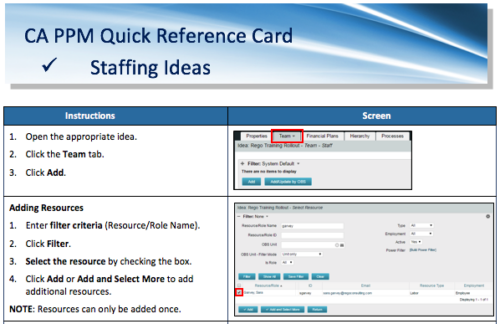
  • A Quick Reference Card to assist in adding resources and roles to Ideas in the Classic UX.  Updating Allocation is also covered.
  • This training document is a Rego Consulting Quick Reference Guide to assist with the Staffing Plan.  The document reviews accessing the Staffing Page, viewing Resource Allocations, adding Allocations, and the Staff Tab Legend.
  • This training document is a Rego Consulting Quick Reference Guide to assist with resource staffing in Clarity’s Modern User Experience.  The document reviews accessing Staffing from the main menu, the Staffing Grid, and the Allocations Timeline.
  • This training document is a Rego Consulting Quick Reference Guide to assist with staffing the Idea Team in Clarity’s Modern User Experience.
  • A Quick Reference Guide to assist in the staffing of an Idea in Clarity’s Classic UX.
  • A Quick Reference Guide to assist in Staffing an Idea Team in Clarity.  The document uses the Classic UX with the Phoenix theme.
  • A Quick Reference Guide that covers how to staff a Team in Clarity’s Modern UX.  It reviewes some of the key terminology, covers Allocation vs. ETC, accessing the Staffing Tab, and viewing time-scaled allocations.
  • This training document is a Rego Consulting Quick Reference Guide to assist with the process of staffing a Team in Clarity’s Modern User Experience.  The document starts with a review of common terms, then setting default allocation, Allocation vs ETC, and then the Staffing Tab.
  • Course Description:   How do companies track stage gates within Clarity PPM? This session will review some best practices for tracking, monitoring, and approving stage gates within Clarity PPM. We will also discuss pros and cons of various options to help you select the best method for your company.
Go to Top